I start on a lark and finish in more serious reflection.
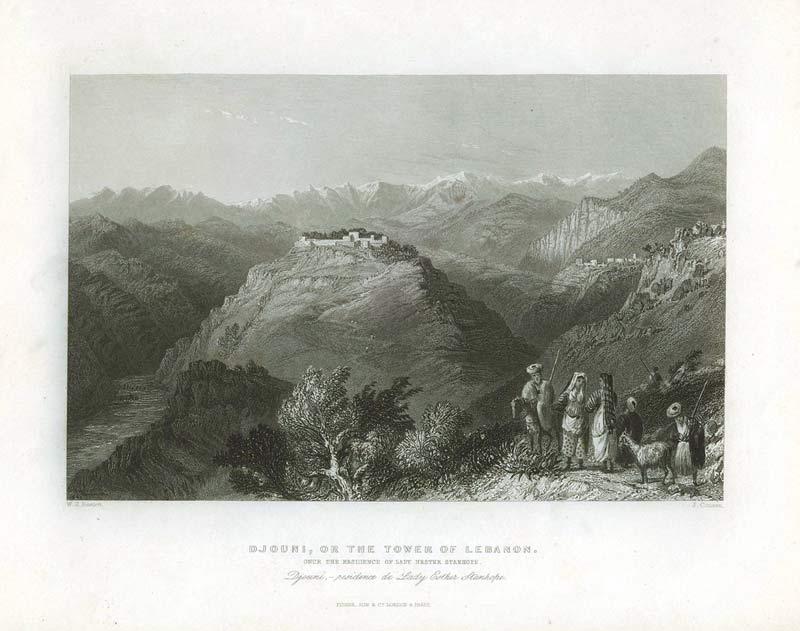
I was a bit surprised, although also delighted, to learn that the oft-referenced Ivory Tower comes to us, not by way of some resentful rusticated Cantabrigian (I’m not that elite – I googled “student at Cambridge, figuring – rightly – there would be some fancy-footwork way of saying it – but the way, I am hereforward a Connecticutian – that last “t” soft, as in Liliputian…because why not while we speak of this’s and that’s), but by way of (you’re still with me in this sentence, right?), the Bible. In the Song of Songs, a virtuous maiden has (ready for it?) a neck like a “tower of ivory” and (if that’s not enough) “yes like the fishpools in Heshbon,” which was no doubt praise in very strong language indeed! The delight continues. (Oh, and to explain the picture – it goes on: “your nose is as the tower on the Lebanon looking over Damascus,” which is of course a compliment without match. When you want to glorify without veering into anything dangerously, you know, physical, sticking to architectural landmarks is always a good choice!
Thanks to Steven Shapin’s studious article in the British Journal for the History of Science, a publication that (more delight), makes “important and lively contributions” to “all aspects of the history of science,” (did I mention he’s a Harvard Scholar – wonderful!), we can learn that ivory pops up not only in that Bible passage but in the Odyssey and other classical sources as a symbol of fantasy – perhaps also of illusion, of “the imaginatively unreal” (2). Then safely in the hands of medieval and Renaissance Catholics, it’s back to the purity ideal as the ivory tower becomes a stand-in for the Virgin Mary (and makes a clever appearance in that guise in Joyce’s Ulysses).
We’re not there yet, of course, because how we get from architecturally pure necklines to the elitist remove of the academy requires another jog or two, which of course Dr. Shapin helpfully explains. Somewhere in the middle of the 19th century, the tour d’ivoire enters the aesthetic realm, and becomes a way of calling an intellectual reclusively aloof (as did Charles Augustin Sainte-Beauve call Alfred de Vigny, saying Vigny’s hiding away in his estate “as if in his ivory tower, retired before noon” (3). At which point the meme went viral, or the late 19th century equivalent. In Shapin’s view (based on quite impressive research of the phrase and I’m not being facetious – well not at least about the thoroughness of his investigation – it’s a wonderful piece! – it’s clear to me now why I failed to get published as I finished my PhD) Americans take over the phrase at the start of the 20th century. Of course we do; we do it so thoroughly. Which all adds up to – oh, the delight – broad use of the term by the 50s, by which time no one has an f-in clue what it (ever) meant. Which, as Shapin notes, “is much what one would expect,” given that so much time has passed and the meaning is undergoing rapid shifts (4). Bonus for me, a lifelong Henry James lover, is that of course in 1917 his (James’s) posthumous novel (unfinished, even better, somehow fitting) The Ivory Tower gets published although (oh, delight) “ivory-towerness had little to do with the themes of the book” (5, Shapin I’m not kidding here, deserves an award for that “ivory-towerness,” which makes me hold onto a belief with little basis that he’s well-aware of the, er, ivory-towerness of the whole article!).
Best “find” in Shapin’s article is a quote from Flaubert, who puts to words a later 19th-century sentiment that (at least to an artist) retreating to ivory towers was something longed for, if difficult to achieve, for the sake of one’s art: “I Have always tried to live in an ivory tower, but a tide of shit is beating at its walls” (5, quoting Flaubert in a letter to Turgenev). And now things get personal: the Kansas City Star ridicules Flaubert’s overly French-y ivory-towerness (I’ll never give up that phrase now!) in favor of “many” Anglo-Saxon artists like William Morris. I know, wait, you were just thinking: William Morris, the quintessence of 19th-century ideals of masculinity! Then the Marxists get on board (it was only a matter of time), slamming everyone, and at last (full circle!) we’re back in Connecticut with Wallace Stevens in his own bid for a manly aesthetic, dissing his friend William Carlos Williams for his ivory-towered stance (5).
I’ll leave Dr. Shapin alone, and hope (if he ever reads this) that he can tell by my delighted summary, that I am in some awe of his investigative skills (as a librarian, I’m particularly impressed). Unfairly, I’ve offered only bits of his lead-in, as the remainder of his article takes us through the tower’s wartime journeys and eventual beleaguered position as an essential refuge of art in the face of cries to enter (literally) the fray of the real [sic] world. Importantly, and interestingly, the ivory-towerness expands to encompass science as well as art, and both its defenders and critics cement its place in our culture even while exploding any specific, shared understanding. It’s by the 1930s that the idea of the Tower attaches to universities and higher education broadly. The “quiet” of the university becomes less defensible against fascism (15). Astutely, Shapin details how defense of ivory-towerness becomes particularly reprehensible during and after the war in the fields of science, when any claim of detachment could be countered with evidence of the many alignments between scientific research and the war-industrial complex (19-20 in particular). Shapin finishes with what rang true I’m sure in 2012 when the article was published and even truer perhaps now:
Today, almost no one has anything good to say about the Ivory Tower and specifically about the university in its supposed Ivory Tower mode. Those who might be supposed to value a degree of disengagement largely keep their heads down, or, if they wish to limit the continuing enfolding of the university in civic economies, invoke the Ivory Tower in what must be ironic tones: the Ivory Tower as leased, sold, sold for thirty pieces of silver, sold out, needing to be reclaimed, in escrow–that same Ivory Tower which those fighting a rearguard action must know never existed but whose violated purity can in no way be better expressed. (25)
Ultimately, Shapin argues (because there is an argument in the exegesis) that the modern banishment of us from the Tower reflects the embrace of the “active” over the reflective. The tension and continued debate (across a couple centuries more or less) between engagement in society and detachment from it for the sake of intellectual rigor has been demolished by the current (as he wrote in 2012) imperative to rid ourselves of the tower – so the debate, in his own turn of phrase, has become a “monologue” (or “rant”) against the tower, one we may come to regret (26-27).
Sitting in a chair in a tower (room above the garage) arranged to work-live through the pandemic, I’m struck by how quickly my own delight in the absurdity of it all (ivory necks, fishpool eyes, nose-towers and the tide of shit swamping Flaubert’s sought retreat) diminished as I started to hear the debate playing out in my own professional-human experience.
What is the call to mindfulness or the contemplation of one’s “EQ” or one’s “strengths” (choose your brand) if not a carving out of what is perceived as necessary mental seclusion. Always with the idea that such withdrawal is in preparation for better engaging with fellow humans, for having more capacity to make positive impacts on a real world. Carve out Time Outs for meditation, to recall and record what we are grateful for, to journal ourselves away from negative self-talk toward self-realization, efficacy, and success.
Recently I and a group pondered how much overlap one could find between Emotional Intelligence education and work to support Justice, Equity, Diversity, Access, and Inclusion. (There are books already published touting that overlap). We’ve spent two years being reminded to carve out spaces, literal and/or imaginative, to practice self-care and healing. To breathe, to push pause, to close our eyes, replenishing and expanding our own-ness. Great work if you can get it, of course. Like putting on your own oxygen mask before that of your child (do people actually do that?), we’ve been told to gird our own fortresses of the mind-psyche. So that. So that we can be better people, or more human (somehow) and in doing so we’ll all heal and be better. While artillery shatters, while children starve or are slaughtered, while hatred and un-sense trampels common space and shared experience (and that’s just starting with recent headlines).
Yet even in our work to act we promote ivory-towered discourses that no one posts to a church door to spur action – or perhaps exactly like theses on a church door, are posted to the world, requiring hours to digest and act upon (or not act upon) – perhaps acting upon only rhetorically in more discursive response (like this, you say, yes exactly like this!). So even our most active arms of the academy, the modern ivory tower, however edge-embracing, celebrate deliberative contemplation as itself an act of resistance solidarity allyship, a pre-amble, leading out of the gates of the tower an army of words in the service of and themselves action.
So I’ll agree with Shapin that the one-sided call to Leave the Tower! fails us. Although. Although it’s an uncomfortable balance to strike between introspection and action. Can EI segue into action, strike out of reverie? Perhaps. But not all towers are equal, there’s no Ivory Tower embodying all instances of intellectual activity encouraged and supported by time-space carved out in its service. Discourse can take us to the gates of the tower (impossible to avoid naval-gazing metaphor here!) or bind us within, caught in a self-perpetuating echo chamber.
Lucky for us all, she of ivory neck and towered nose finally broke free of her pedestal and had a thing or thousand to say. To shut the ivory tower now would be to let it crumble right as others demanded the keys. The trouble with the ivory tower is its self-justifying remove. That neck was never anyone’s to enplinth. If we leave the tower it’s because it was never the right metaphor. It’s the right to be part of the rigorous discourse of art and science and humanity we’re fighting for and fuck the assholes who locked it up in a tower to begin with.
 MadcapAcad